In many breweries and beverage co-packing facilities, pasteurization monitoring still looks the same: a handheld thermometer, a few spot checks, and a temperature written down during the run. It’s familiar, fast, and widely accepted as “good enough.”
But familiarity doesn’t equal compliance.
Roughly 70% of breweries and co-packers rely on discontinuous methods, meat thermometers, manual readings, or endpoint checks to document pasteurization. While these practices feel responsible, they do not meet FDA expectations under FSMA for validated thermal processes.
FSMA changed the rules. Pasteurization is no longer something you verify after the fact. It’s something you must be able to prove continuously, with defensible time–temperature data from the process itself.
And that’s where the gap appears.
A meat thermometer captures a moment, not a process. A few readings don’t demonstrate lethality. And temperatures taken outside the product say nothing about what happened at the geometric cold spot, the slowest-heating point where risk actually lives.
Most teams don’t realize this until they’re asked one question: Can you show continuous data for this SKU, on this run, without explaining it away?
If the answer is no, the risk already exists.
What the Regulations Actually Say (Not What We Think They Say)
Under FSMA 21 CFR Part 117, two sections matter most when it comes to pasteurization.
117.160 – Validation
Facilities must be able to scientifically prove that their pasteurization process consistently delivers the required lethality under real operating conditions, using actual process data.
117.145 – Monitoring
Once validated, that process must be continuously monitored. This means tracking time and temperature throughout the entire run to show the process stayed within validated limits—not just at a few points in time.
This is where many facilities unknowingly fall out of compliance.
Spot checks are not monitoring, manual readings are not continuous, and the temperature measured on the outside of a can or bottle is not the same as the temperature at the geometric cold spot, the slowest-heating point where pathogens are most likely to survive.
Pasteurization happens over time. Lethality accumulates gradually as the product heats, holds, and cools. If you cannot show time–temperature data across the entire pasteurization cycle, you are not validating a process.
You’re documenting a moment and hoping the rest of the story holds up.
Snapshot vs. Movie: Why Pasteurization Can’t Be “Checked”
Think of pasteurization like a movie.
A meat thermometer gives you a snapshot, one frame in time. It might look fine. It might even look perfect. But it tells you nothing about what happened before or after that moment.
Pasteurization Units (PUs) don’t appear instantly. They accumulate over time as the product heats, holds, and cools while moving through the tunnel. Lethality is delivered gradually, not at a single temperature check. Miss part of that curve, and you miss the story of what actually happened to the product.
That’s why spot checks fall short. They capture moments, not behavior. The FDA doesn’t want snapshots. They want the movie.
That means:
- Continuous temperature measurement
- At the geometric cold spot
- Across the full duration of the run
- With records that can’t be altered after the fact
Manual methods simply can’t deliver that level of visibility or proof.
What Happens When the Gap Gets Exposed
This isn’t theoretical.
In January 2024, Barsotti Juice received an FDA Warning Letter after regulators determined the facility could not adequately validate its thermal process. The issue wasn’t intent; it was documentation and proof.
On the brewery side, under-pasteurization has triggered costly downstream consequences. 450 North Brewing, among others, faced exploding-can recalls tied to surviving yeast and refermentation. These events routinely cost $100,000–$500,000 per incident, before brand damage is even counted.
In nearly every case, the root cause traces back to insufficient process visibility, not bad beer, not bad people.
Why Continuous Monitoring Changes Everything
This is where systems like the SCOUT fundamentally change the equation.
Instead of checking pasteurization from the outside, SCOUT travels with the product through the tunnel, measuring what actually determines safety, quality, and compliance. It captures the process as it unfolds, not after the fact.
That gives teams visibility into what truly matters:
- Continuous temperature data, not isolated readings
- True geometric cold spot behavior, where risk actually exists
- Real-time PU accumulation across the full pasteurization cycle
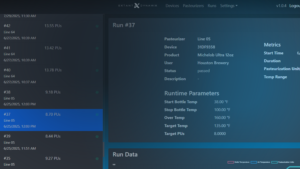
The SCOUT doesn’t operate alone. Its data flows into the COMMANDER, which aggregates in-process measurements, calculates PUs automatically, and generates tamper-evident, audit-ready records without manual handling or interpretation.
For facilities that need reliable connectivity and secure data continuity beyond the tunnel, the LIEUTENANT acts as the always-on bridge, ensuring data is captured, preserved, and accessible whether the network is local or cellular.
Together, the system replaces snapshots with a complete, defensible record of what actually happened during each run.
And here’s the part most teams don’t expect: compliance unlocks throughput.
When operators can see the full PU curve instead of guessing, conservative safety margins shrink. Over-processing drops. Teams gain confidence to tune SKUs intentionally instead of running everything “just in case.” Decisions move from habit to data, without adding complexity to the floor.
Better data doesn’t slow production. It makes higher throughput repeatable.
The Question Every Facility Should Ask
If an FDA auditor walked in tomorrow and asked you to show proof of pasteurization for a specific SKU, on a specific line, at a specific time, could you do it without explanation?
Could you show the movie, not just describe it?
If the answer depends on assumptions or verbal justification, there’s a gap worth addressing. Not because teams are careless, but because modern regulations demand proof that stands on its own.
In today’s regulatory environment, confidence isn’t about hoping you’re compliant. It’s about knowing you can prove it; clearly, completely, and without hesitation.